Electrical Safety Compliance Fundamentals: A Complete Guide for Australian Workplaces in 2026
Key Takeaways
Question Answer What standard governs electrical testing in Australia? AS/NZS 3760:2022 is the primary standard for in-service safety inspection and testing of electrical equipment across Australian workplaces. Who is responsible for electrical safety compliance at work? Employers and persons conducting a business or undertaking (PCBUs) have a primary duty of care under work health and safety legislation, including obligations enforced by WorkSafe Victoria. What is portable appliance testing? Portable appliance testing involves a visual inspection and electrical test of all plug-in equipment using a calibrated PAT device, resulting in a pass or fail tag on every item. Do businesses in Melbourne need test and tag services? Yes. Businesses throughout electrical safety compliance Melbourne requirements must have portable appliances regularly tested, especially in high-risk environments such as construction, hospitality, and healthcare. How often should RCD testing be performed? RCD testing Melbourne professionals recommend testing residual current devices at least every 12 months for fixed RCDs and every three months for portable RCDs on construction sites. Where can I find professional test and tag services in Melbourne? Site Safe Test and Tag provides comprehensive test and tag services across the CBD, north Melbourne, and western suburbs. What documentation should a compliance test produce? A compliant test should produce a same-day digital report, a full asset register, and colour-coded pass/fail tags on every item, all ready for a WorkSafe Victoria or insurance audit.
What Are Electrical Safety Compliance Fundamentals?
Electrical safety compliance fundamentals refer to the set of practices, standards, and documentation requirements that employers must follow to ensure all electrical equipment and installations in a workplace are safe for use.
At their core, these fundamentals cover four key areas: regular inspection and testing of electrical equipment, maintaining accurate records of all tests performed, removing faulty equipment from service immediately, and ensuring that safety devices such as residual current devices (RCDs) are functioning correctly.
In Australia, the benchmark for these practices is set by AS/NZS 3760, the Australian and New Zealand standard for in-service safety inspection and testing of electrical equipment. Compliance with this standard is not merely best practice; it is the minimum expectation of regulators including WorkSafe Victoria.
For businesses across greater Melbourne, understanding and implementing these fundamentals protects both workers and the organisation from legal, financial, and reputational risk.
Understanding AS/NZS 3760 and Its Role in Electrical Safety Compliance Fundamentals
AS/NZS 3760 is the cornerstone of electrical safety compliance fundamentals in Australia and New Zealand. The standard specifies how portable and transportable electrical equipment should be visually inspected and electrically tested throughout its service life.
The 2022 revision of AS/NZS 3760 introduced updated testing intervals based on the risk level of the working environment. Construction sites, for example, require more frequent testing cycles than low-risk office environments.
The standard mandates that every tested item must be tagged with key information including the test date, the name of the testing technician, and the date by which the item must be re-tested. This tag is the visible proof that a business is meeting its electrical safety compliance Melbourne obligations.
Businesses that cannot produce tagged equipment and supporting records during a WorkSafe Victoria inspection face the risk of improvement notices, prohibition notices, and significant financial penalties.
A concise visual guide outlining the three essential steps to electrical safety compliance. Helps readers implement fundamentals in workplace safety programs.
Portable Appliance Testing: A Core Component of Electrical Safety Compliance Fundamentals
Portable appliance testing (PAT) is the hands-on process by which a qualified technician inspects and electrically tests every plug-in device in your workplace. This process sits at the heart of any robust electrical safety compliance fundamentals program.
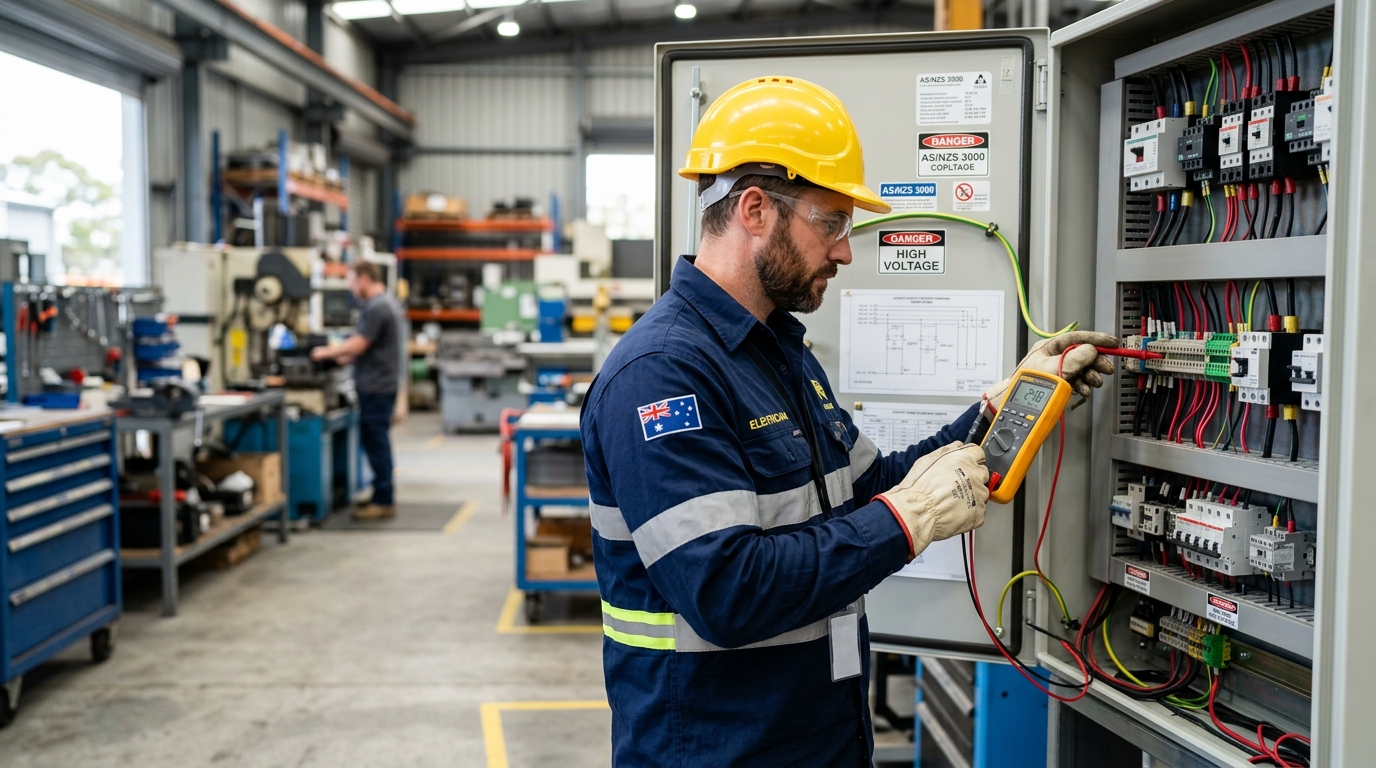
PAT involves two distinct phases. The first is a thorough visual inspection, checking for damaged cables, cracked casings, loose plugs, and any other visible signs of wear or damage. The second is an electrical test using a calibrated Portable Appliance Tester, which measures insulation resistance, earth continuity, and other electrical parameters.
Every item that passes receives a colour-coded pass tag. Every item that fails is immediately removed from service and clearly identified. This straightforward process is what makes electrical test and tag Melbourne services so valuable to businesses of all sizes.
For businesses requiring test and tag Melbourne compliance, working with a dedicated provider ensures that the correct testing intervals under AS/NZS 3760 are applied for your specific industry and environment.
Did You Know?
Thermal burns from arc flashes account for up to 80% of all OSHA-reported electrical injuries.
Source: Gitnux / IEEE 2026
RCD Testing Melbourne: Why Residual Current Devices Cannot Be Ignored
RCD testing Melbourne businesses need to understand that residual current devices are among the most critical safety components in any electrical system. An RCD is designed to cut power within milliseconds when it detects a fault current, preventing electrocution.
However, the presence of an RCD does not guarantee protection. Research has shown that 50% of Ground Fault Circuit Interrupters fail to operate correctly after just five years in the field, which means a device that appears to be in place may offer no real protection at all.
Under AS/NZS 3760, RCDs must be tested at defined intervals depending on their type and location. Portable RCDs used on construction sites require testing every three months. Fixed RCDs in standard workplaces should be tested at least annually.
Professional RCD testing Melbourne services use calibrated trip-time testing equipment to confirm that each device will operate within the required response window. This testing is a non-negotiable element of electrical safety compliance fundamentals and must be documented in your compliance records.
Failing to test RCDs is one of the most commonly cited deficiencies during WorkSafe Victoria inspections. It is a relatively simple step that can mean the difference between a minor incident and a fatality.
WorkSafe Victoria and Electrical Safety Compliance Fundamentals in the Workplace
WorkSafe Victoria is the state authority responsible for enforcing work health and safety legislation across Victorian businesses. When it comes to electrical safety compliance fundamentals, WorkSafe Victoria expects employers to demonstrate active, documented compliance, not merely intent.
An inspector visiting your premises may request to see your test and tag records, your RCD testing logs, your asset register, and evidence that faulty items have been removed from service. If your documentation is incomplete or out of date, your business is exposed to formal enforcement action.
Beyond documentation, WorkSafe Victoria also expects that persons performing electrical testing are competent. This means your testing provider must hold the relevant qualifications and use properly calibrated equipment in accordance with AS/NZS 3760.
For businesses across test and tag CBD locations and surrounding suburbs, partnering with a qualified provider such as Site Safe Test and Tag ensures that all compliance records are accurate, up to date, and audit-ready at any time.
Test and Tag Services Across Melbourne: CBD, North, and Western Suburbs
Businesses throughout greater Melbourne have distinct compliance needs depending on their industry, the nature of their equipment, and their location. Whether your premises are in the city centre or outer suburbs, electrical safety compliance Melbourne requirements apply equally to all.
For businesses requiring test and tag CBD services, the high density of commercial office buildings and hospitality venues means a large volume of portable appliances must be tested regularly. IT equipment, kitchen appliances, cleaning equipment, and portable power tools all fall within the scope of AS/NZS 3760 testing obligations.
In test and tag north Melbourne areas, the mix of light industrial, retail, and residential-adjacent commercial properties creates varied compliance demands. Businesses in these precincts often have equipment spread across multiple floors or facilities, making a structured asset register particularly important.
For test and tag western suburbs clients, the prevalence of manufacturing, warehousing, and construction-related businesses means higher-risk environments where more frequent testing cycles are required. The western suburbs corridor includes some of Melbourne's most active industrial zones, and portable appliance testing schedules must reflect that risk level.
Regardless of your suburb or industry, a professional electrical test and tag Melbourne provider will assess your specific environment, determine the correct testing frequency under AS/NZS 3760, and deliver a complete compliance solution.
"Every portable electrical appliance in your workplace carries risk if it is not regularly inspected and tested. Under AS/NZS 3760:2022, employers have a duty of care to ensure all in-service electrical equipment is safe."
Site Safe Test and Tag
What a Professional Test and Tag Service Delivers for Electrical Safety Compliance Fundamentals
When you engage a qualified provider for test and tag Melbourne compliance, you should expect a comprehensive service that goes well beyond simply attaching stickers to appliances. A thorough portable appliance testing engagement includes the following deliverables:
Full visual inspection and electrical testing of every portable appliance on your premises using a calibrated PAT device
Colour-coded pass/fail tags applied to every item, clearly showing the test date, technician name, and re-test due date in compliance with AS/NZS 3760
Same-day digital compliance report delivered to your nominated contact, providing a complete record of all items tested and their results
Full asset register listing every item by location, make, model, and test outcome, ready for a WorkSafe Victoria or insurance audit
Immediate removal of faulty items from service, with clear identification and notification to your team
RCD testing performed to the intervals required for your site type under the standard
This level of documentation is what transforms a routine inspection into genuine electrical safety compliance Melbourne coverage. It protects your workers, satisfies your legal obligations, and gives management confidence that the workplace is electrically safe.
Businesses that request test and tag north Melbourne or test and tag western suburbs services from Site Safe receive this full suite of compliance outputs as standard, not as an optional add-on.
Did You Know?
50% of Ground Fault Circuit Interrupters (GFCIs) fail to operate correctly after 5 years in the field.
Source: UL / Gitnux 2026
Building a Workplace Program Around Electrical Safety Compliance Fundamentals
A one-off test and tag visit is a good starting point, but true electrical safety compliance fundamentals require an ongoing, structured program embedded in your workplace's safety management system.
The following framework represents best practice for building a sustainable compliance program in 2026:
Conduct an initial site audit. Identify every portable appliance, fixed installation, and RCD across your premises. This forms your baseline asset register.
Determine testing frequencies. Use AS/NZS 3760 to establish the correct re-testing interval for each item category based on your environment and industry risk level.
Schedule recurring test and tag visits. For electrical test and tag Melbourne businesses, scheduling quarterly or annual visits in advance ensures no items fall outside their re-test window.
Maintain centralised records. All compliance reports, asset registers, and RCD test logs should be stored in a single location accessible to management and available for immediate production during a WorkSafe Victoria inspection.
Remove and quarantine faulty items immediately. Faulty equipment must never be returned to service until it has been repaired and re-tested by a qualified person.
Review and update the program annually. As your business acquires new equipment or changes its operations, the compliance program must be updated to reflect the new asset landscape.
Businesses operating across test and tag CBD premises and multiple suburban locations should consider a provider capable of servicing all sites under a single compliance program, ensuring consistent standards are applied across the entire organisation.
Common Gaps in Electrical Safety Compliance Fundamentals and How to Address Them
Even well-intentioned businesses regularly fall short of full electrical safety compliance fundamentals. Understanding the most common gaps helps you address them proactively before a WorkSafe Victoria inspection or, worse, a workplace incident.
Gap 1: Inconsistent testing intervals. Many businesses test some appliances regularly but overlook others, particularly in shared areas such as kitchens, meeting rooms, and storage spaces. A complete asset register eliminates this blind spot.
Gap 2: No RCD testing program. As noted above, RCDs can fail silently. Businesses that have never arranged formal RCD testing Melbourne services may be relying on devices that no longer provide protection.
Gap 3: Outdated or incomplete records. Tags on appliances and digital reports held by a testing provider are only useful if they are current and accessible. Records older than the applicable re-testing interval provide no compliance coverage.
Gap 4: Untested new equipment. New appliances are often plugged in and used without being entered into the testing program. Under AS/NZS 3760, new equipment should be inspected and tagged before first use in certain environments.
Gap 5: Treating compliance as a one-time task. Electrical safety compliance is an ongoing obligation. A certificate from two years ago does not protect your workers or your business today.
Conclusion
Electrical safety compliance fundamentals form the foundation of a safe, legally compliant workplace in Victoria and across Australia. From adhering to AS/NZS 3760 and conducting regular portable appliance testing to maintaining rigorous RCD testing Melbourne schedules and keeping records ready for WorkSafe Victoria audits, every element of this compliance framework exists to protect people from serious harm.
Whether your business needs test and tag CBD services in the heart of Melbourne, coverage across test and tag north Melbourne precincts, or comprehensive test and tag western suburbs programs for industrial sites, the fundamentals remain the same: inspect, test, tag, document, and repeat on schedule.
Achieving and maintaining electrical safety compliance Melbourne standards is far more straightforward when you work with a qualified, experienced provider. We encourage all businesses to review their current compliance status and take action before the next scheduled inspection, not after an incident occurs.
Frequently Asked Questions
What are the electrical safety compliance fundamentals every Australian workplace must follow?
The core electrical safety compliance fundamentals every Australian workplace must follow include regular inspection and testing of all portable appliances in line with AS/NZS 3760, mandatory RCD testing at prescribed intervals, proper tagging of all tested equipment, and maintenance of accurate compliance records. These obligations are enforced by regulators such as WorkSafe Victoria, and failure to comply can result in improvement notices, prohibition orders, and significant fines.
How often should test and tag be done in Melbourne workplaces?
Electrical test and tag Melbourne frequency depends on the type of environment and equipment. Under AS/NZS 3760, high-risk environments such as construction sites require testing every three months for portable equipment, while low-risk office environments may only require testing every five years for stationary items. A qualified test and tag Melbourne provider will assess your specific site and recommend the correct schedule.
Is test and tag required by law in Victoria in 2026?
Yes. In 2026, Victorian employers are required by the Occupational Health and Safety Act and supporting regulations to ensure that all electrical equipment in their workplace is safe for use. WorkSafe Victoria uses AS/NZS 3760 as the accepted standard for meeting this obligation, making portable appliance testing and tagging a practical legal requirement for most workplaces.
What is the difference between test and tag and RCD testing?
Test and tag refers to the visual inspection and electrical testing of individual portable appliances, resulting in a pass or fail tag on each item. RCD testing Melbourne is a separate process that verifies residual current devices (safety switches) will operate correctly by measuring their trip time under simulated fault conditions. Both processes are required under AS/NZS 3760 and form part of a complete electrical safety compliance fundamentals program.
Can I perform test and tag myself, or do I need a qualified technician?
Under AS/NZS 3760, testing must be performed by a person who is competent in the inspection and testing process. In most cases, this means a licensed electrician or a person who has completed specific training in portable appliance testing. For businesses seeking reliable electrical safety compliance Melbourne outcomes, engaging a dedicated professional provider is the most practical and legally defensible approach.
What records do I need to keep for electrical safety compliance in 2026?
To satisfy electrical safety compliance fundamentals requirements, you must maintain a complete asset register listing every tested item, the date of testing, the test result, the technician's name, and the next re-test date. Your records should also include RCD test logs and any documentation related to faulty items removed from service. These records must be available on request during a WorkSafe Victoria inspection or insurance audit.
Does test and tag cover all suburbs in Melbourne including the western suburbs and north Melbourne?
Yes. Professional providers offering test and tag Melbourne services typically cover the full metropolitan area, including test and tag CBD commercial premises, test and tag north Melbourne residential and mixed-use properties, and test and tag western suburbs industrial and manufacturing facilities. Site Safe Test and Tag services all of these areas, delivering consistent electrical safety compliance Melbourne standards regardless of your location.
